PGCET MBA exam pattern and last-minute tricks 2026
PGCET MBA exam pattern and last-minute tricks 2026
The Karnataka PGCET MBA 2026 is an offline, OMR-based state-level entrance examination that determines admission to postgraduate management programs. It consists of exactly 100 objective questions divided equally across five distinct sections, totaling 100 marks with a strict 120-minute duration. The exam features zero negative marking, allowing candidates to safely maximize their scoring potential through calculated attempts. Achieving a top state rank requires strategic time allocation and precision in high-yield sections like Quantitative Analysis.
Core Facts: PGCET MBA 2026
What is the exact section-wise pattern for PGCET MBA 2026?
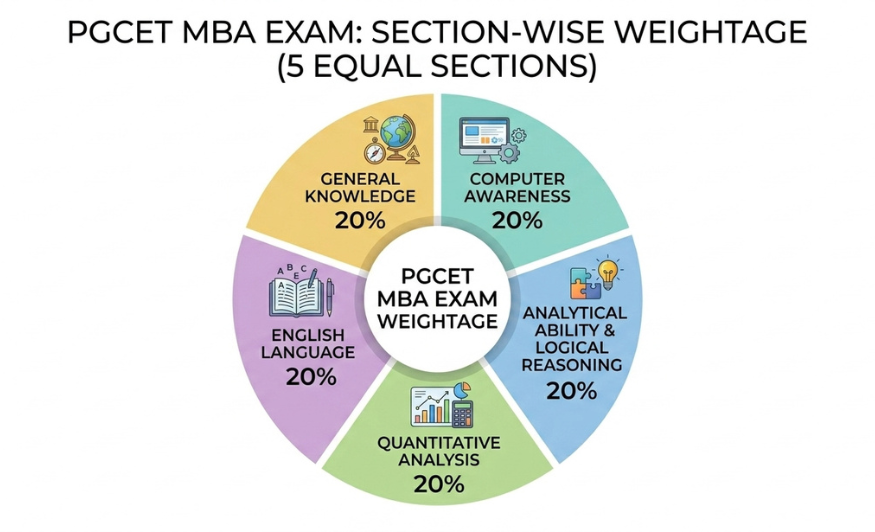
The Karnataka PGCET MBA is a postgraduate assessment that allocates 100 multiple-choice questions symmetrically across five testing domains. Candidates face exactly 20 questions each in Computer Awareness, English Language, Logical Reasoning, Quantitative Analysis, and General Knowledge. The complete absence of sectional time limits provides strategic flexibility during the 120-minute testing window.
Unlike the MCA format, the MBA examination distributes its weightage perfectly evenly. No single section dominates the total score, making balanced proficiency crucial for clearing high-tier college cutoffs.
| Section Focus | Total Questions | Marks per Question | Total Marks |
|---|---|---|---|
| Computer Awareness | 20 | 1 | 20 |
| Analytical Ability & Logical Reasoning | 20 | 1 | 20 |
| Quantitative Analysis | 20 | 1 | 20 |
| English Language | 20 | 1 | 20 |
| General Knowledge | 20 | 1 | 20 |
| Overall Total | 100 | - | 100 Marks |
What is the optimal time-management strategy for the PGCET MBA?
Effective time management is a structural methodology that maximizes total score output within a fixed 120-minute constraint. Candidates must target a strict baseline of 72 seconds per question. Solving the Computer Awareness and General Knowledge sections rapidly accumulates immediate marks, thereby reserving vital minutes for the mathematically intensive Quantitative Analysis section.
The KEA exam pattern allocates exactly 120 minutes for 100 questions, resulting in a mathematical necessity to average 24 minutes per section. Top-percentile candidates typically complete the General Knowledge and English sections in under 15 minutes each. This strategic reallocation allows them to dedicate up to 40 minutes exclusively to complex logical reasoning puzzles and arithmetic word problems.
What are proven last-minute tricks for the PGCET MBA?
Last-minute exam optimization is a tactical approach that prioritizes high-yield revisions over learning net-new concepts. Implementing strict execution protocols during the final 48 hours mathematically improves your baseline output.
- Exploit the Zero Negative Penalty ProtocolThe PGCET MBA operates on a zero negative marking system. Leaving a blank bubble on the OMR sheet is a mathematical error. You must reserve the final 5 minutes of your session to strategically bubble every single unanswered question, as an educated guess carries zero statistical risk.
- Prioritize Quantitative Formulas Over Deep TheoryThe Quantitative Analysis section consistently tests fundamental arithmetic. Refreshing core formulas in Percentages, Profit & Loss, Ratios, and Simple/Compound Interest yields immediate returns. Attempting to master complex probability distributions two days before the exam induces cognitive fatigue.
- Simulate Physical OMR Friction Digital mock tests fail to replicate the physical friction of bubbling answers. Print official OMR sample sheets and practice transferring your answers in batches of 10 or 20. This batch-processing method prevents catastrophic, late-stage misalignment errors on the physical answer sheet.
FREQUENTLY ASKED QUESTIONS (FAQs)
The Karnataka PGCET MBA is an examination that features absolutely zero negative marking. Candidates receive one mark for every correct response and face zero score deductions for incorrect or unattempted guesses.
The baseline eligibility is a recognized Bachelor's degree of minimum 3 years duration, requiring a minimum aggregate of 50% across all years for unreserved categories (45% for SC/ST and Category-1 candidates of Karnataka state).
Also Read:
Follow Us
.svg)